

Silicon


East view of AMD's future 300mm fab in Dresden.

North view of AMD's future 300mm fab in Dresden.

AMD is increasing production at Dresden to cope with extra demand; Sun Microsystems has for example recently chosen the AMD Opteron™ processor.

The new facility is next to AMD's Fab 30.

AMD's Dresden site is already one of the most important industrial sites in eastern Germany.

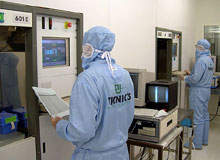
Etch tool hookup at Fab 30.

Litho area at Fab 30.

AMD's Athlon™ microprocessor is produced in Dresden.


Artist’s impression of ASMC’s new 200mm wafer fab.

The new fab will also be located in Shanghai.

ASMC has a wafer supply agreement with California Micro Devices, which produces devices including ASIPs and analog semiconductors.

The ASMC/Jazz alliance will bring ASMC’s capacity to 100,000 wafers per month.

Jazz’s mixed-signal and RF ICs are being made in ASMC’s fab.

Chinese RF IC manufacturers now have access to SiGe, RF, and analog foundry services.

China could become the world's largest semiconductor consumer by 2010.

China’s market even grew in 2001, when demand in the rest of the world dropped.


The Crolles research facility is located at Grenoble, France.

System on Chip devices are increasingly being used in equipment like set-top boxes.

Crolles will be studying SRAM and other memories.

Each of the partners brings its own expertise. Motorola's SMARTMOS™ medium voltage process integrates power, analogue and digital logic.

STM has been chosen by CERN for the ALICE (A Large Ion Collider Experiment) project. An IC integrates 16 data acquisition channels.


The new fab is Hiroshima Elpida's second 300mm facility.

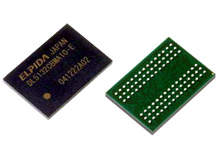
Elpida is producing 512Mbit Mobile RAMs at the site.

The company is increasing production to cope with demand from components like 128Mbit DDR SDRAMs.

Digital Consumer DRAM Devices will also be produced at Hiroshima.

DDR2 Registered DIMMs are aimed at the server market.

Elpida Memory's 64Mbit SDR Mobile RAMs work in cellular applications.

Elpida Memory and Hiroshima Elpida Memory have constructed a second 300mm wafer fab in Hiroshima.

300mm wafers at the new Hiroshima plant have reduced manufacturing costs and expanded capacity.


Fujitsu's Technology Center consolidates all aspects of its 90nm chip development activities.

Evaluation board for Fujitsu's CMOS 10Gbit/s Parallel Transmissions interface for standard logic LSI devices.

Fujitsu uses tools from major EDA companies like Synopsys, Cadence and Mentor Graphics.

Low-voltage (1.8V) 128Mbit flash memories have 8.5ns access times in burst mode at 80MHz.

The company has various processes with different power/performance ratios.


'Main Street' at the East Fishkill IBM fab, where a 300mm facility is under construction.

Mask development.

Operator inspecting 300mm wafer.

IBM's 300mm wafer fab at East Fishkill, NY.

300mm wet etch/oxide.

300mm analysis with wireless PC.

300mm robot arm.


Infineon has reached the cross-over point, where 300mm devices cost less than 200mm ones.

Production costs are expected to fall by 30% in the new fab.

512Mbit DDR2 (second-generation Double-Data-Rate) SDRAMs will go into next-generation servers, workstations, high-end PCs and notebooks.

Infineon has agreed a technical co-operation deal with Ferrari on advanced racing systems.

Infineon's 'virtual' microcontrollers attempt to leapfrog Moore's law, increasing electronic system performance while reducing costs.

SOLID stacking connects multiple chips for 3D chip integration in 'system-in-package' electronics.


Intel's Ireland campus at Collinstown Industrial Park, Leixlip, County Kildare, is Intel's largest fab outside the United States.

Intel has spent $2 billion on its Irish facilities, in ramping up 90nm production and introducing 65nm processes.

The investment added an extra 6,000m² of manufacturing cleanroom space.

The 300mm Fab 24 is Intel's third 90nm facility, and its fourth to manufacture 300mm wafers.

Intel's 65nm process uses strained silicon, eight-layer copper interconnects, and low-k dielectrics.

Intel has already used its 65nm process to make a 70Mbit SRAM.


Aerial photograph of Micron's Manassas site.

Micron's Manassas facility, where the 300mm pilot line will run.

Implant, where wafers are bombarded with dopant ions.

Technicians service equipment from maintenance bays without entering the fabrication bays.

At wafer saw, a diamond-edged blade cuts the finished wafer into the individual dice.

The Photo Area.

Operator visually inspecting a wafer.

The heads inside Pick and Place machines pick components out of feeders using vacuum nozzles, placing them on printed circuit boards.


Samsung's DDR2 DIMMs are in volume production, storing from 256MB to 2GB.

XDR DRAMs have an order of magnitude higher performance than today's standard memories.

DRAM has difficulty keeping up with high-speed CPUs. Instead, SDRAMs process data at the same speed as the system clock.

SDRAM can process large volumes of data at high speed.

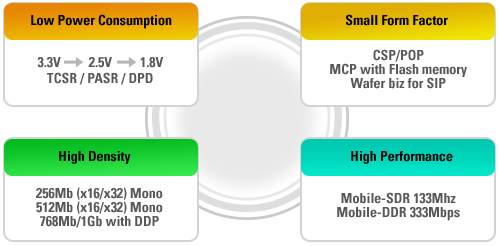
The mobile SDR/DDRs are low-power devices for handheld equipment like mobile phones.

High-speed SDRAM works in PCs, servers, networks and consumer equipment.


Soitec is adding a 300mm line at Bernin (France).

Soitec's Unibond SOI process.

Soitec makes wafers between 100mm and 300mm.

200mm and 300mm Unibond roadmap.

Industry analysts anticipate that 300mm SOI wafers will make up 50% of all wafers taken by the industry by the year 2009.


View of the SSMC semiconductor facility in Singapore.

The SSMC site during construction in January 2000.

The SSMC site during construction in February 2000.

The SSMC site during construction in May 2000.

The US$1.2 billion 8-inch fab is a joint-venture between TSMC, Philips Semiconductors and Singapore's EDB Investments.


Digital still camera block diagram.

Worldwide manufacturing and design locations.

TI's view of the DSP and analog era.

IP Video phone block diagram.


Simulation and production line design allows early start-up of mass production. (Courtesy Toshiba)

Toshiba’s manufacturing information control, production planning and process design and evaluation systems. (Courtesy Toshiba).

Flash memories give higher reliability and better performance than hard disk drives. (Courtesy Toshiba).

Toshiba’s new fab makes flash memories, used in equipment like its ON-AIR MAX ™, a multi-purpose video server. (Courtesy Toshiba).

ON-AIR MAX and Flash memory product roadmap. (Courtesy Toshiba).

Increased device demand has prompted Toshiba to build a new NAND flash memory fab. (Courtesy Toshiba).


Newsletter Sign-Up
For all the latest news in the semiconductor industry, sign up here

Home
New On This Site
Products & Services
Company A-Z
Projects
Features
White Papers
Jobs & Careers
Innovations & Updates
Gallery
Events Listings
Newsletter
Advertise
About Our Services
Client Area


RSS What is RSS
News, views and contacts from the semiconductor industry